
Educational content only. Not investment advice. This lesson explains how to read a chart. It doesn't tell you to buy or sell anything.
By the end of this lesson you can: classify what happened at a mapped liquidity level on a closed M15 candle as a sweep, a breakout or neither, using measurable rules, and explain why some candles are set aside.
Two outcomes at the same level
In the last lesson you built a map of levels where resting orders are assumed to sit. When price reaches one of them, two broad things can happen:
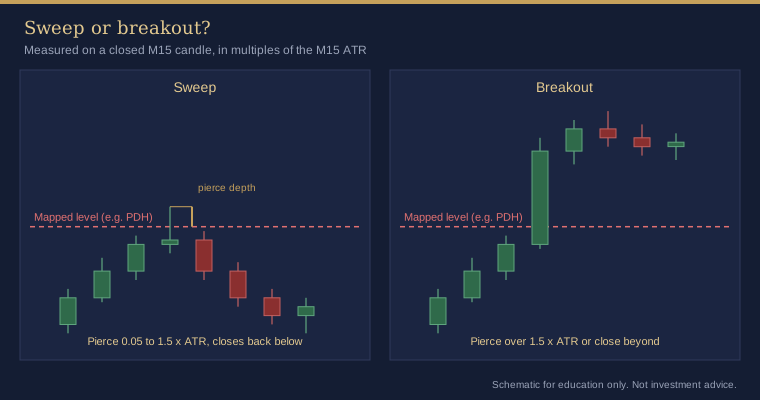
- Sweep: price trades beyond the level, triggering the orders assumed to be there, and then closes back on the original side. The move beyond was short-lived.
- Breakout: price trades beyond the level and stays there, closing beyond it or moving so far that "short-lived" no longer describes it.
They can look the same for most of a candle. The difference is only clear when the candle closes, which is why this course classifies closed M15 candles only.
A measurable definition
Words like "a little beyond" and "rejected" are too vague to test. This course uses three numbers, all in multiples of the M15 ATR, so they adjust to gold's changing volatility.
For a buy-side level (above price), a closed M15 candle is a sweep when:
- Pierce. Its high is above the level.
- Depth band. The distance from the level to the high is at least 0.05 ATR and at most 1.5 ATR.
- Close back inside. It closes below the level.
Sell-side levels are the mirror image: the low goes below the level by 0.05 to 1.5 ATR and the candle closes above it.
Each limit has a purpose:
- Below 0.05 ATR the pierce is too small to tell apart from noise and spread, so it is ignored.
- Above 1.5 ATR the move went too far beyond the level to call it brief. Even if the candle closes back inside, this course treats it as a breakout and doesn't use it as a sweep.
- A close beyond the level is never a sweep, however shallow the pierce.
These are teaching defaults, not facts about the market. The point is that they are written down, so you can change one number and see what changes.
Candles that are set aside
Some candles are ambiguous, and a rule set needs to say what happens to them.
- Both sides swept in one candle. A wide candle can sweep a buy-side level and a sell-side level at the same time. It's unclear which sweep matters, so this course skips the candle entirely.
- Several levels on one side. One candle may sweep a single swing high and the PDH just above it. Choose the highest-priority level (Lesson 20). If two have the same priority, choose the more extreme one: the highest for buy-side, the lowest for sell-side.
- Unclear higher-timeframe structure. If the last two M15 swing highs and lows show a higher high together with a lower low (an expanding range), the structure is classed as unclear and the sweep is ignored by default. Lesson 26 covers this filter in full.
Being strict here means fewer events, but each one can be checked. Allowing every ambiguous candle produces more examples and less you can learn from them.
A sweep is a starting point, not a conclusion
A sweep only records that a level was pierced and price closed back inside. It doesn't say what happens next. A sweep can be followed by a strong move away from the level, by a slow drift, or by a breakout a candle later that makes the sweep look meaningless. This course needs two more steps after a sweep before anything is considered complete: a change of character on the lower timeframe (Lesson 23) and a retest (Lesson 24). Many sweeps never get that far, and recording those is part of the work.
Common mistakes
- Calling a sweep before the M15 candle has closed.
- Counting a deep pierce as a sweep because the candle eventually closed back inside.
- Using a level that wasn't on the map before the candle, which is drawing liquidity after the event.
- Showing only sweeps followed by a large move.
How the indicator shows this
The AURUM Liquidity Retest indicator checks for a sweep at every M15 close, against the map from Lesson 20:
- Min sweep pierce (default 0.05 × M15 ATR) and Max sweep pierce (default 1.50 × M15 ATR, input note: "deeper = breakout") set the depth band. The candle must also close back on the original side of the level.
- If one candle sweeps both a buy-side and a sell-side level, the panel shows "Both sides swept, skipped".
- If several levels on one side qualify, it picks the highest priority, and then the more extreme price.
- With HTF structure gate at its default, Block unclear structure, a sweep is ignored when M15 structure is unclear (HH with LL) or there isn't enough history. The panel shows "Sweep ignored: …" with the reason.
- The indicator follows one setup at a time. While a setup is in progress, later sweeps aren't picked up.
- After a valid sweep it looks for a recent lower-timeframe swing to use as the CHoCH level. If none is found, the panel shows "Sweep ignored: LTF unclear".
- On the chart, a valid sweep is drawn as a solid line from the level to the sweep's extreme, an arrow at the extreme, and a label such as
SWEEP BSL PDH. The tooltip gives the level, its price and the M15 candle time. Alert on liquidity sweep is off by default. Turn it on to be notified when a sweep is recorded.
Key takeaways
- A sweep pierces a mapped level by 0.05 to 1.5 × M15 ATR and closes back inside, judged on the closed candle.
- A deeper pierce, or a close beyond the level, is treated as a breakout.
- Ambiguous candles are set aside: both sides swept, or unclear structure.
- A sweep is the first step of a sequence. It isn't an outcome or an instruction.
Practice exercise
- Using your liquidity map from Lesson 20, go through two days of XAUUSD M15 candles one at a time, hiding the candles to the right.
- For each candle that reaches a mapped level, measure the pierce in ATR and record sweep, breakout, too shallow or skipped (both sides).
- Find one valid sweep and one deep pierce that closed back inside but went beyond 1.5 ATR. Put them side by side.
- Change the maximum to 1.0 ATR and then 2.0 ATR. Count how many sweeps you get with each and write down what changed.
Not investment advice. This lesson is for education only. Trading leveraged products such as CFDs on gold carries a high risk of losing money quickly. Examples are illustrative and say nothing about future results.