
Educational content only. Not investment advice. This lesson explains how to read a chart. It doesn't tell you to buy or sell anything.
By the end of this lesson you can: label a break of structure (BOS) and a change of character (CHoCH) on a chart, explain why the indicator needs a candle close, and say what happens when swing and internal breaks occur together.
From pivots to breaks
The last lesson defined pivots and the HH/HL/LH/LL sequence. A structure break is the moment price closes beyond the most recent confirmed pivot that hasn't been broken yet:
- A close above the latest pivot high is an upward break.
- A close below the latest pivot low is a downward break.
Whether that break is called a BOS or a CHoCH depends on the direction structure was already going.
BOS: break of structure
A BOS is a break in the same direction as the current structure. If the last break was upward and price now closes above the next pivot high, that is a BOS. It records that the existing sequence continued for one more step.
CHoCH: change of character
A CHoCH is the first break against the current structure. If the breaks so far have been upward and price now closes below the most recent pivot low (the last higher low), that is a CHoCH. It records that the sequence was interrupted.
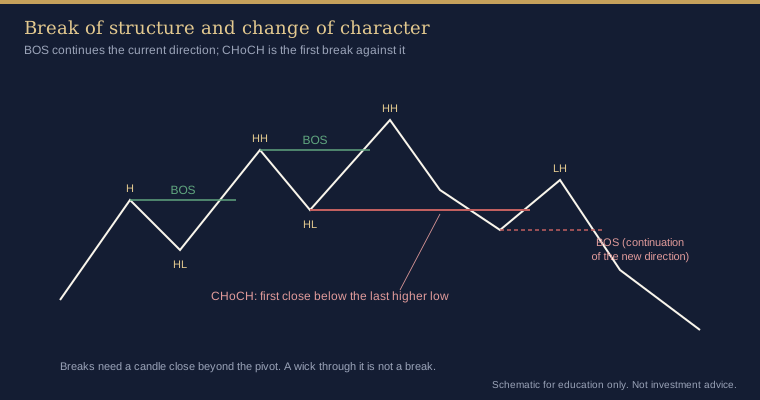
Note the words records and interrupted. A CHoCH doesn't announce a reversal. It reports that one pivot was closed through. Price often makes a CHoCH and then carries on in the original direction, producing a CHoCH the other way soon afterwards. After a CHoCH, the next break in the new direction is a BOS, because the new direction is now the "current" one.
Why the close matters
The indicator counts a break only when a candle closes beyond the pivot. A wick that pokes through and closes back inside isn't a break.
There are three reasons for this:
- Gold spikes. News, thin liquidity and spread widening can push a wick a long way through a level for a few seconds. A close filters out much of this.
- It can't change afterwards. A closed candle is final. A break defined by a close stays fixed once it is printed, while a break defined by the live price can appear and disappear within one candle.
- Wicks have their own meaning. A wick through a pivot that closes back inside is what later lessons call a sweep. Keeping wick events and close events separate stops two different ideas from being mixed up.
The cost is lateness: a close-based break is always known at the end of the candle, never during it. On H1 that can be up to an hour after the price first crossed.
Swing breaks and internal breaks
Swing and internal structure are tracked separately, so each layer has its own BOS and CHoCH:
- An internal CHoCH inside a larger upward swing structure is common. It may be only a pullback.
- A swing CHoCH needs a close through a major pivot and happens far less often.
- The two layers can disagree. A swing BOS upward and an internal CHoCH downward can both appear within a few candles of each other.
Some candles break both layers at once. Decide in advance which layer your analysis uses, and write both down.
Common mistakes
- Counting a wick through a pivot as a BOS.
- Treating every CHoCH as a reversal and ignoring how often it is followed by a CHoCH the other way.
- Mixing internal and swing breaks in one narrative ("it broke structure") without saying which.
- Forgetting the lag: the pivot being broken was confirmed several candles after it formed (Lesson 10), and the break itself is known only at the candle close.
How the indicator shows this
In the Smart Money Concepts indicator, the structure engine runs once for the swing layer and once for the internal layer on every closed candle:
- Close required. A break is recorded only when a candle's close is beyond the latest unbroken pivot. Each pivot can be broken once, and the next break needs a new pivot.
- BOS or CHoCH. If the layer's last break was in the opposite direction, the new break is labelled CHoCH. Otherwise it is labelled BOS. This includes the very first break after the indicator loads, when there is no earlier direction to compare with.
- On the chart. Each break is a horizontal line from the broken pivot to the breaking candle. Upward breaks use the up-break colour (green by default) and downward breaks the down-break colour (red). Swing breaks are solid and labelled
BOS/CHoCH. Internal breaks are dotted and labellediBOS/iCHoCH. Max structure labels kept (default 60) limits how many stay on the chart. - Same-candle events. Within one layer, an upward break is checked before a downward one, so one candle gives at most one event per layer. If both layers break on the same candle, the indicator uses the internal event for its later scoring.
- Which breaks get scored. The Signal trigger input sets which breaks the indicator goes on to evaluate with its confluence score (Lessons 18 and 19): CHoCH only, CHoCH + trend-aligned BOS (the default; a BOS counts only when it matches the swing layer's direction), or Every internal BOS / CHoCH. This changes what gets scored, not how breaks are drawn.
- Order blocks. Each break also creates an order block from the leg before it. That is the subject of Lesson 12.
Key takeaways
- BOS: a close beyond a pivot in the current direction (continuation). CHoCH: the first close beyond a pivot against it (interruption).
- Breaks need a candle close. A wick through and back is a different event: a sweep.
- Swing and internal layers each have their own BOS and CHoCH. Always say which one you mean.
- A CHoCH reports a broken pivot. It doesn't confirm a reversal.
Practice exercise
- On XAUUSD M15, find a swing CHoCH followed by an internal BOS in the new direction. Mark the broken pivot, the breaking candle and its close, with UK times.
- Find one case where a wick crossed a pivot but no candle closed beyond it. Note what price did over the next ten candles.
- Find one CHoCH that was followed within a day by a CHoCH back in the original direction.
- If you have the indicator, switch off internal structure, then swing structure, and see how the story of the same day changes.
Not investment advice. This lesson is for education only. Trading leveraged products such as CFDs on gold carries a high risk of losing money quickly. Examples are illustrative and say nothing about future results.